

The Formula to Avoid Disappointment | Share Orit’s Sanctuary

Dear Sanctuary friends,
Lately, I’ve been reflecting on disappointment—not the dramatic, life-changing kind—but the quieter ways it slips into everyday life. I’ve felt it recently in moments like these:
- A surprise I was hoping for that never came.
- A hug I longed for that didn’t happen.
- A vacation with my family that never materialized.
- A colleague missing a deadline.
- A message I wished would have not been sent from an organization I support.
- Even something as small as the gardener forgetting to prune the flowers.
And then there are the deeper disappointments, when we long for comfort and connection during painful times—like when I hoped a friend would reach out after my family in Israel was under rocket fire, or after an antisemitic remark became evident in the public media.
We often think of disappointment as a human emotion—the look in our eyes when things don’t go as planned, the slump in our shoulders when we’ve hoped for more. But if you’ve ever lived with a dog, you’ve seen it: disappointment has a tail, and it can hang low. I’ll elaborate on this later.
 Beyond my own disappointments, we all have our list. Here are some universal ones (you’ve probably felt some today):
- The long-awaited Amazon package that arrives two days late.
- The group photo where everyone looks great…except ourselves.
- The promotion at work that went to someone else.
- The weekend getaway when it rained the whole time.
- A beloved TV series capped off by a finale that falls flat.
- A text message left without reply.
- The scale in January. Enough said.
Disappointment is one of the most universal human emotions—experienced by children when a birthday gift doesn’t match their hopes, by adults when a promotion doesn’t come, by our dogs waiting for a treat, or even by entire communities when expectations about leaders or nations are unmet.
Take a minute to reflect
- What are a few small or large disappointments you’ve carried recently?
- Were they tied to expectations you set, or promises others made?

 What is disappointment?
Psychologists define disappointment as the negative emotional response we feel when outcomes don’t meet our expectations (van Dijk & Zeelenberg, 2002).
Disappointment is closely tied to the gap between what we hope for and what actually happens.
Disappointment always carries the sting of unmet anticipation.
In simple terms: disappointment is hope wearing mismatched shoes—it stumbles as soon as it tries to walk into reality.
The anatomy of disappointment
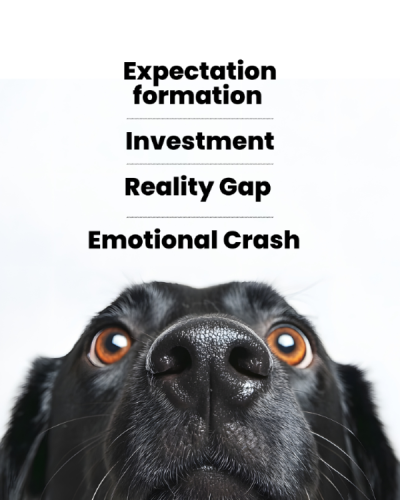
- Expectation formation—We imagine a particular outcome.
- Investment—We attach emotions, identity, or resources to that expectation.
- Reality gap—The actual outcome differs from the imagined one.
- Emotional crash—The resulting gap produces frustration, sadness, or even anger.
 Disappointment, in essence, is hope interrupted by reality.
If disappointment hurts, why do we keep setting ourselves up for it?
A graphic shows expectation formation, investment, reality gap, emotional crash
Humans are natural forecasting machines. We constantly predict the future because it helps us feel in control. Despite the pain, we are wired to expect good things. Dreams and wish lists, by their very nature, sit outside the realm of reality. They are often based on idealized scenarios, not on what is probable or within our sphere of influence. This doesn’t mean they are meaningless—dreams inspire—but when confused with realistic expectations, they become fertile ground for disappointment.
Part of the answer lies in optimism bias—a common cognitive bias—our natural tendency to believe good outcomes are more likely than they are. This bias helps us stay motivated, but it also makes us vulnerable to disappointment when things don’t go as planned. We attach ourselves to imagined outcomes. When reality doesn’t follow our script, we feel let down.
Take a minute to reflect
- Where in your life are you holding on to the illusion of control?
- How might letting go ease your heart?
Ways to avoid or mitigate disappointment (with a wink)
Disappointment is inevitable, but it doesn’t have to run the show. Avoiding disappointment doesn’t mean abandoning hope or ambition. It means holding our expectations lightly and grounding them in reality. If disappointment is fueled by unrealistic expectations, the antidote lies in expectation management.
10 ways to soften the blow of disappointment
 1. Check your expectations. If your bar is set at “perfect,” lower it. Perfection is the exception, not the rule.
2. Ask, don’t assume. People can’t read your mind (even if they love you). Ask for the hug. Focus on what you can do: “I will reach out to my kids and suggest time together,” rather than, “They will join me on vacation.”
3. Focus on effort, not outcome. You control the input, not the outcome. Instead of expecting outcomes (“I will be promoted”), focus on process (“I will develop three new skills this year”).
4. Use the “Will it matter in a year?” test. Spoiler: the gardener’s missed flowers won’t. Other expectation audit questions to ask yourself: “Did I clearly ask for what I expect? Is this probable or just possible? Is there anything I need to do to avoid (as much as possible) being disappointed?
5. Keep humor handy. If the pasta’s burnt, order pizza and call it “gourmet.”
6. Practice gratitude. Gratitude rewires the brain toward resilience and significantly reduces the sting of disappointment by shifting focus on what is present, not absent.
7. Separate dreams from goals. Dreams and wish lists can inspire, but they must be seen for what they are: aspirations, not guarantees. Dream: “I want to win the lottery.” Goal: “I want to save $200 a month.”
8. Reframe disappointment. Instead of seeing it as failure, see it as data: “This shows me where my expectations were misaligned with reality.”
9. Collect small joys. A good ice cream can save a disappointing day.
10. Remember it’s not personal. Most unmet expectations are about circumstance, not rejection.
Avoiding disappointment means choosing expectations wisely. I’m sure you heard this important reminder before: It’s not events that upset us, but the expectations we attach to them.
Take a minute to reflect
- Which one of these 10 do you want to practice this week?
- How might it change the way you handle your next disappointment?
The Formula for Making a Request (and avoiding disappointment)
One of the best tips I’ve learned for avoiding disappointment is simple: Clearly ask for what you expect and need. Think of it as giving the other person the gift of not disappointing you. People can’t read our minds. Just because you want something doesn’t mean anyone else knows exactly what that is.
For example, I might ask you for a coffee, and you’ll happily agree. And yet I still end up feeling disappointed because I was expecting a small coffee with two Splendas and skim milk delivered exactly five minutes before my next meeting. Oops! I just said “coffee” and skipped all the details.
 Here’s a formula I swear by
- Never make “by the way” requests. Those casual asks create the biggest setup for disappointment. Take the time to clearly state what you want.
- Don’t assume anyone knows your expectations. Spell them out!
- Share your conditions of satisfaction and make sure the other person can fulfill those expectations. For example: “I’d love a small coffee with two Splendas and skim milk in the next five minutes. Can you do that?”
- Ask if they have any questions or need more info. This ensures everyone is on the same page.
And here’s the twist: If you want to avoid disappointing others, use the same formula in reverse—ask clarifying questions and make sure you understand expectations. Disappointments will still happen, because life is life, but we can do our best to mitigate them.
Realistic Expectations are Key
Disappointment is part of life. A little disappointment is okay—it keeps us human. But when it defines our lives, it robs us of joy.
 The truth I’ve come to realize is this: realistic expectations rarely disappoint. Dreams and wish lists are beautiful, but they live outside our control. When we separate them from our daily expectations, we can live with more ease, humor, and grace.
I can still hope for surprises, for hugs, for understanding, for shared vacations. But if they don’t come, I need to remind myself that I need to request and plan for them. And life, when lived with flexible hope and grounded expectations, becomes less about disappointment and more about discovery.
As the English poet Alexander Pope once said: “Blessed is he who expects nothing, for he shall never be disappointed.”
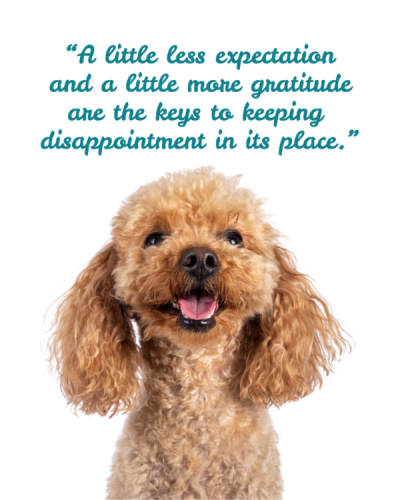
I wouldn’t go that far—we need hope to live. But maybe, just maybe, a little less expectation and a little more gratitude is the key to keeping disappointment in its place.
Fetching Joy Through our Four-Legged Friends
Now back to our dogs. Dogs don’t speak our language, but they feel our absence, our moods, our broken promises. They wait for walks that never happen, for car rides that turn out to be vet visits. Their eyes can say everything we try to hide—the quiet ache of unmet expectations.
I’ve seen it in my dog Addie’s face when I grab my shoes, and she thinks it’s time for an adventure—only to realize I’m leaving without her. She doesn’t bark or protest. She just sits there, still and heavy, looking away as if to say, “I thought this was our time.”
 In my book, The Box of Life: A Guide to Living with Purpose and Preserving What Matters Most, I talk about how every emotion—even the painful ones—deserves a place in our box. Not as something to relive, but as something to remember. Our disappointments, tell stories about what we long for, what we value, and what we care about deeply.
When I think of Addie’s quiet disappointment, I also think about loyalty. About trust. About the moments when love waits at the door even when I don’t show up as expected. It’s a lesson in grace—to accept that others, and even we ourselves, will sometimes fall short.
Preserving these moments in our Box of Life isn’t about collecting sadness. It’s about collecting truth. Because life is made of the full spectrum—from wagging tails to heavy sighs, from fulfilled dreams to quiet letdowns. Each one teaches us resilience, patience, and tenderness.
Perhaps the next time we see disappointment in a pair of gentle brown eyes, we can pause and honor it—not as failure, but as love waiting for its next chance to be expressed. That’s how disappointment shows in dogs—not with anger, but with silence. A pause. A sigh.
And yet, here’s the miracle: dogs don’t stay disappointed for long. They don’t carry grudges or replay moments of letdown. One kind word, one pat, one walk—and the tail starts wagging again. Their forgiveness is immediate, their love unshaken.
 If only we could learn from that.
To feel our disappointment, to acknowledge the hurt, but not to live in it.
To remember that love, loyalty, and presence are stronger than any letdown.
Disappointment in dogs reminds us that expectations are born from love. And love, when nurtured, always finds its way back to joy.

Sign up for updates or request a
complimentary consultation