

The Cervecita That Changed Everything – Create a Box of Life This Spring

There’s a photo on my phone I keep coming back to.
My dad is sitting in his favorite chair. Black leather recliner, the kind that swallows you a little when you sink into it. He’s wearing his pale-yellow shirt, the soft one. His glasses are slightly crooked on his face, the way they always were. And he’s smiling.
If you knew my father during his last years on this earth, you’d understand why that smile stopped me in my tracks.
Parkinson’s doesn’t just steal movement. It quietly negotiates with your face until the expressions that used to come easily — the grin, the raised eyebrow, the look that said, “I see you, and I love you” — become harder to access. Not gone. Just … rationed. You learn to notice the micro-expressions. The softening around the eyes. The almost-there.
But in this photo? Full smile. Unambiguous. The kind I hadn’t seen in a while.
The reason? A can of Heineken 0.0.
Una Cervecita
 Every appointment with his cardiologist followed the same script.
We’d sit in the waiting room —my aba (dad in Hebrew) and I —and he’d already be preparing his case. Like a lawyer organizing his arguments before appearing in court. He always asked three things:
• “Can I have a little wine on Friday for Kiddush?” (Friday night blessing)
• “Una cervecita?” (One beer, in Spanish)
• “Can I travel to Israel?”
These were not frivolous questions. They were identity questions. The wine for the Shabbat kiddush (Friday night blessing) was not optional — it was the punctuation mark at the end of a sacred sentence.
The cold beer on a warm afternoon was una cervecita, said the way only someone who’s truly earned it can say it.
And Israel? That was the thread that connected everything. His roots. His story. His proof that something impossible had become real in his lifetime.
For months, the cardiologist said, “I don’t recommend it.”
And then one day, he said, “Yes.”
I remember the way my heart sank when I heard it. Because I understood, the way you understand things you don’t want to understand, what that “yes” meant. When the doctor stops protecting you from what you want, it’s not always liberation. Sometimes it means the fight is changing shape.
But that’s not the part I want to write about today.
The Gift That Understood Everything
 It was Father’s Day. My son, Ilan, gave his grandpa a gift.
He gave him a Heineken 0.0 — non-alcoholic beer, which at the time was just beginning to be more than a niche novelty. Cold. In a can. The real thing, in every way except one.
And my father’s face, that face that had been fighting with Parkinson’s for years, lit up.
Not because he was fooled. He knew exactly what it was. That was never the point.
He held it. He felt the cold of the can. He cracked it open — that sound, you know the one. He lifted it and tasted it. And for a moment, he was somewhere else but again himself, entirely.
Because here’s what Ilan understood that the rest of us had missed: it was never about the alcohol.
It was about the experience. The ritual. The Saturday afternoon feeling. The memory of being healthy and free and present.
The simple, uncomplicated pleasure of a man enjoying a beer. All of that was still available. All of it. Every part of it, except the one part that was getting him into trouble.
What We Think We’re Losing (and What We’re Actually Losing)
I’ve been sitting with this memory for years now. In moments when I or someone I love is told, “you can’t do that anymore.” In coaching conversations, when someone says, “I used to be someone who (fill in the blank), and now I’m not.”
We are remarkably bad at separating the essence of something from its form.
When my aba was told he couldn’t drink even a little alcohol, he — and honestly, most of us — collapsed the two, essence and form.
No cervecita = no grounding.
No wine = no Shabbat feeling.
But that was wrong. What he wanted was not the ethanol. He wanted the ritual. The grounding. The sensory memory of a life fully lived. The feeling of being present in a moment that felt like him.
That feeling is almost always available to all of us in some form. Almost always. We just have to be creative enough and honest enough to find it.
The Substitution Isn’t a Consolation Prize
 Here’s where I want to push back on something, gently.
We often treat adaptations as lesser. As if the non-alcoholic beer is a sad substitute. As if the modified yoga pose is the failure version. As if the slower walk is just evidence of what’s been lost. We frame the adaptation as proof of the limitation, and so we resist it — or worse, we pity it.
But watch my father’s face in that photo.
That is not the face of consolation. That is not well, this will have to do.That is yes. This. Right now.
The experience was whole. It was complete. It was, in the ways that mattered most, exactly what he wanted.
We confuse adaptation with diminishment because we’re afraid. If we accept the modified version, are we giving up? Are we admitting defeat? Are we settling?
No. We are doing something much more sophisticated: we are identifying what we value — stripped of the form we’re attached to —and finding a way to honor it anyway.
That’s not settling. That’s wisdom.
The Coaching Lens (Because I Can’t Help Myself)
I work with leaders who are in transition — sometimes by choice, often not. Organizational restructuring. Aging parents. A role that changed shape. A market that moved. A body that renegotiated the terms.
The ones who struggle most are the ones who can’t distinguish between what I do and why I do it. The form and the essence.
The executive who defined themselves by their title discover they don’t know who they are without it — when what they valued was impact, credibility, and being in the room where decisions are made. Those things don’t live in a title. They live in them. They’re still available in a different room or table. Their essence is still available in a different form.
Here are the four questions I carry with me, and offer to you:
1. What is an experience you think you’re losing? Not the activity. Not the form. The experience. The feeling underneath.
2. Which parts of that experience are still available to you? Be specific. Be honest. Be creative.
3. What would it mean to honor what you love — essence — even in a different container — form?
4. Who in your life might be the Ilan in this story? The one who sees not what you can’t have, but what you need, and quietly finds a way to give it to you?
What Ilan Knew
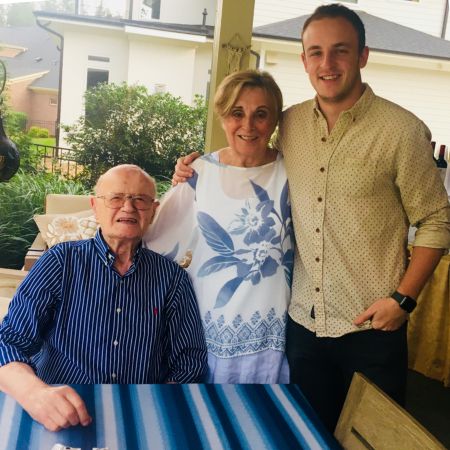 My son was in his early 20s when he gave his grandfather that beer. I don’t know if he thought it through philosophically or if he just felt it the way young people sometimes feel things with a precision that humbles you.
But he understood something profound: Dignity is not about what you have. It’s about whether you still get to experience yourself as yourself.
My father, holding that cold can of Heineken 0.0 on Father’s Day, was not a sick man making do with a lesser life. He was a man who got to feel, for that moment, exactly as he always had. Whole. Present. Grounded in his own experience of being alive.
That smile — that full, unambiguous, Parkinson’s-defying smile — was not about the beer.
It was about being seen, about someone loving him carefully enough to notice what he actually needed and then finding a way to give it to him.
The Last Time He Asked
 I treasure the image of my father smiling, holding a cold can of something that wasn’t quite what it used to be and yet being, in every way that counted, completely satisfied.
Some of the things we think we’ve lost are still here. Waiting in a different form. Ready to give us back to ourselves, if we’re willing to look for them.
Questions to Ponder
- When was the last time you said thank you and truly meant it?
- What is one thing you are grateful for today, even if it feels small?
- How might your outlook change if you paused before judging events and asked, “Good news, bad news — who knows?”
- How could you thank someone specifically — in a way that helps them see their true impact?
This story lives at the heart of the question I invite readers to sit with in The Box of Life, A Guide to Living with Purpose and Preserving What Matters Most: What’s most important to me?
My father knew the answer. He just needed someone who loved him enough to help him find it in a different form.
That question — simple on its surface, profound underneath — is the one I believe every one of us deserves to answer while we still have time to live from that answer.
If you haven’t picked up The Box of Life book yet, this is your invitation. It might be one of the most important conversations you have with yourself this year.
A note before you go: Who in your life might be carrying a version of this story right now, grieving a form, when the essence is still reachable? Sometimes the most profound act of love is helping someone find what they thought they’d lost.
Follow me on social media via the links below and share this sign-up link with friends and loved ones who may be interested in receiving the newsletter from Orit’s Sanctuary.
Warmly,

Start Your Spring by Sharing Your Personal Stories
 Spring is a season that reminds us to begin again — to clear space, nurture what matters and pay attention to the moments that shape our lives.
The Box of Life, A Guide to Living with Purpose and Preserving What Matters Most offers thoughtful prompts and meaningful reflections, which invite you to slow down and capture your stories. The process helps you hold onto the memories and values you want to carry forward.
Welcome to the season of intentional discovery with The Box of Life book.

Sign up for updates or request a
complimentary consultation